AI start-up homepage teardown: why 'AI-powered' tells buyers nothing
AI start-ups took 64% of global venture dollars in Q3 2026, by Crunchbase's count, so 'AI-powered' sets nobody apart. Rewrite your hero to sell the job instead.
"AI-powered" describes how a product works and leaves out what it does for the buyer, and with most venture money going to AI companies, your competitors use the same words. Rewrite the hero around the job instead: the task your product takes off a specific person's plate, and the result in that person's terms. Then show the work, and answer the trust questions before a buyer has to ask them.
The pattern: a method where the job should be
The usual pattern puts a headline about an "AI-powered platform" over a line about transforming how teams work, with a looping product video beside it. Each part describes how the product works. None of it says what job the product does, or for whom, so a visitor has to scroll and guess whether the product is for them.
Why "AI-powered" blends in
So many start-ups now sell AI that the word no longer tells them apart. AI companies made up 44.9% of US venture deals in Q3 2026, and at least 44% in every quarter this year, according to the Q3 2026 PitchBook-NVCA Venture Monitor. They took 82.7% of US deal value through Q3, the highest annual share in PitchBook's data.
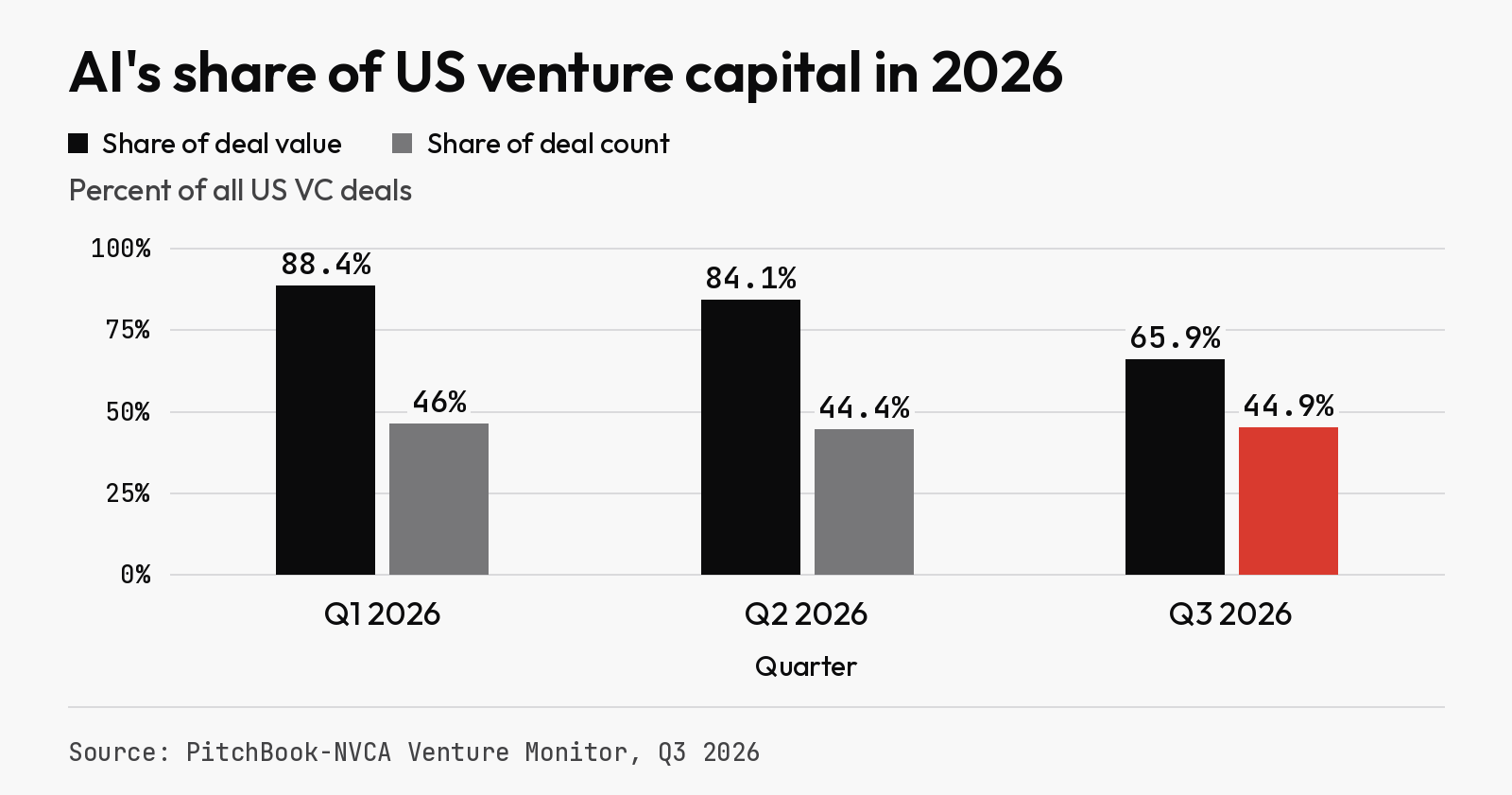
AI's share of US venture deal value and deal count, by quarter, 2026. Source: PitchBook-NVCA Venture Monitor, Q3 2026.
The dollar share fell through the year as the biggest AI lab rounds tapered off, but the deal count barely moved. Worldwide, AI start-ups raised $102 billion in Q3 2026, 64% of all venture funding, according to Crunchbase's Q3 2026 funding data. With that many funded competitors describing themselves the same way, "AI-powered" says very little about yours.
What buyers hear when you say AI
People who work in AI feel far better about it than the public does. In surveys from 2024, 56% of AI experts expected AI to have a positive impact on the US over the next 20 years, against 17% of US adults, according to the Pew Research Center's March 2026 summary of its AI findings.
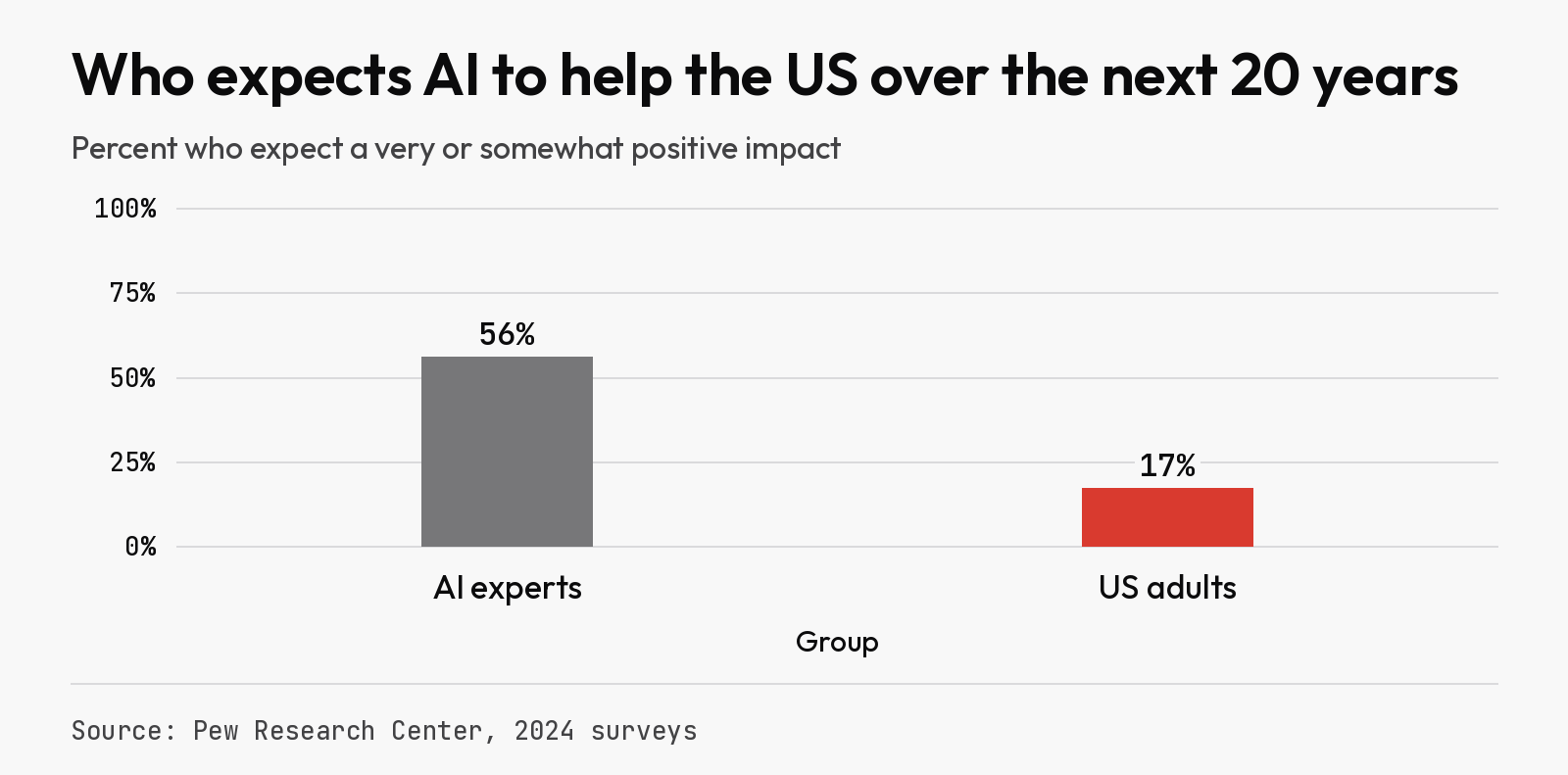
Share who expect AI to have a positive impact on the US over the next 20 years, AI experts and US adults, 2024. Source: Pew Research Center (Mar 12, 2026).
If you founded an AI company, you're likely closer to the experts in that survey than to the public, and your buyers may not be. For a buyer outside tech, "AI" can raise questions about data and accuracy as easily as it raises interest, so the page has to answer them.
Rewrite the hero around the job
Name the person, then the task you take off their plate, then the result in their terms. The example below is invented for this post and isn't any real company's homepage.
| Step | Hero line |
|---|---|
| The usual version | "The AI-powered platform for modern finance teams." |
| Name the person | "Automation for accounts payable teams." |
| Name the task | "Match every supplier invoice to its purchase order." |
| Name the result | "Every supplier invoice matched to its purchase order. Only the mismatches reach your desk." |
The last version doesn't say AI at all. A buyer in accounts payable can tell in one line whether the product is for them. The AI belongs one section down, where the page shows how the matching works.
Show the work
Below the hero, walk through one real task from start to finish: what goes in, what the AI does with it, what comes out, and what a person still reviews or approves. For the invented invoice product, that's an invoice arriving by email, the AI finding the matching purchase order, and a mismatch going to a person with the reason flagged, who approves or rejects it.
Use your product's real screens for this, in the order a user sees them. An abstract animation gives the visitor nothing to check.
Answer the trust questions on the page
A buyer who is about to hand over customer data has questions. Answer them on the page before they have to ask, and describe only what the product does today, in words a customer could check:
- What happens to customer data, and whether it's used to train models.
- Where the models run, and which outside AI providers, if any, process the data.
- A link to a security page.
- A named person to contact, with a real email address.
How we build a start-up homepage
When we build a start-up's site, the top of the homepage says what the product does, and for whom, before anything about how it works. We start with a launch version, the pages a start-up needs to go live, take sign-ups and answer what investors and new hires ask, and build out the full site as a second phase. Sign-up, waitlist and demo forms go straight to the client's CRM and email tool, with analytics from day one.
We also build pages so Google and AI assistants can find the product and describe it correctly, which is the work behind our SEO and AI search service. And on our own service pages, we include a line on who we're not the right fit for. A start-up homepage can do the same.
Next step
Read your homepage aloud to someone outside tech, then ask them what the product does and who it's for. If the answer is "something with AI," rewrite the hero around the job. Our start-up websites page shows how we build a launch version.
Frequently asked questions
Should an AI start-up mention AI on its homepage?
Yes, in the part of the page that explains how the product does the job, below the headline. Buyers and investors will want to know what the AI does, which models or providers you rely on, and what a person still checks. Leading with it is the problem, because it tells a visitor about your method before they know whether you solve their problem.
What is AI washing?
AI washing means claiming more about a product's use of AI than is true. The SEC used the term in March 2024, when it charged two investment advisers with making false and misleading statements about their use of AI (SEC press release on AI washing). Both settled and paid $400,000 in total civil penalties, and SEC Chair Gary Gensler said, "Such AI washing hurts investors." Those cases involved investment advisers, and the rules that apply to your marketing depend on your industry.
Is "AI-powered" still a selling point?
With investors, yes: AI took most of this year's venture money. With the wider public, the word brings mixed feelings. In a June 2025 Pew Research Center survey, half of US adults said the growing use of AI in daily life made them more concerned than excited, up from 37% in 2021. Only 10% were more excited than concerned, which is a reason to lead with the job your product does.
Does an AI start-up need a security page?
If customers will put their data into your product, yes. Say where their data is stored and for how long, who at your company can see it, how it's protected, and how to report a security problem. Link the page from your footer and from your demo and sign-up forms, so a buyer can forward it to whoever approves new software.