Law firm intake response time: secret shop your own firm
In Clio's 2024 secret-shopper test, 67% of firms did not respond to an emailed inquiry. Test your own firm the same way and fix the slowest channel first.
The quickest way to learn your firm's intake response time is to secret shop it: send your own firm a web form and an email, call after hours, and time each reply. When Clio had researchers pose as prospective clients for its 2024 Legal Trends Report, 67% of firms never answered the emailed inquiry.
What Clio's 2024 secret shoppers found
For its 2024 report, Clio had a research firm contact law firms the way prospective clients would, by email and by phone. Only 33% of firms replied to the email, down from 40% in Clio's 2019 test, and 40% answered the phone, down from 56%, according to a summary by the Illinois Supreme Court Commission on Professionalism. Counting callbacks, 48% of firms never answered or called back (Above the Law).
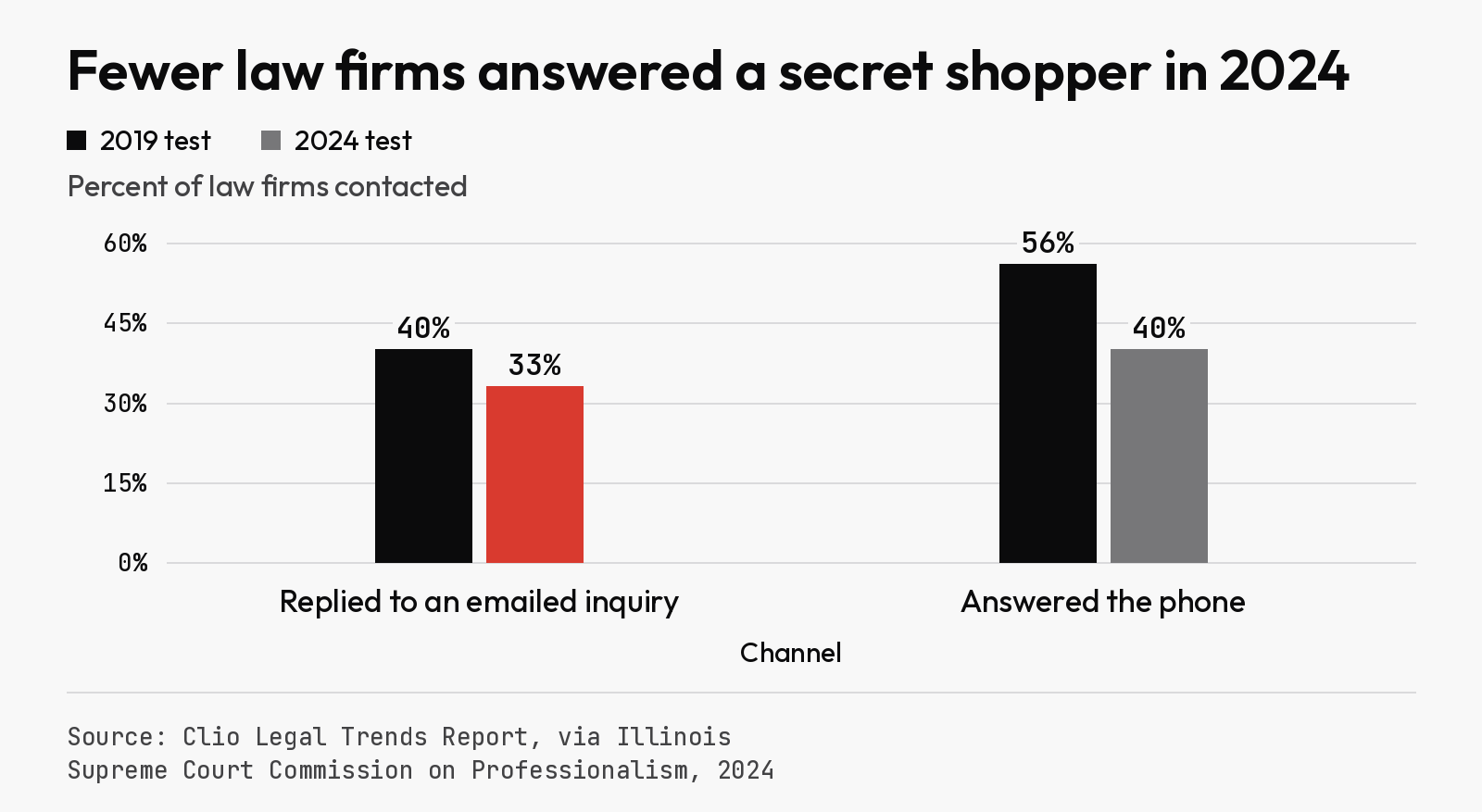
Law firms that responded to a secret shopper, by channel, 2019 and 2024. Source: Clio Legal Trends Report, summarized by the Illinois Supreme Court Commission on Professionalism (Nov 1, 2024).
Both channels got worse over five years, and email drew the fewest replies. Prospective clients expect better: LawSites, citing Clio's Legal Trends Report research, says 79% of them expect a reply within 24 hours.
How to secret shop your own firm
Tell your managing partner before you start, so nobody spends time on a client who doesn't exist. Then:
- Write one inquiry the way a real prospective client would: a common matter your firm handles, a few details and a question about next steps. Make the person up.
- Send it through your website's contact form from an email address the firm doesn't know.
- Send a second version to the email address listed on your site.
- Call the main number after hours and leave a voicemail with a callback number. Call again during business hours on another day.
- Log when each inquiry went out, when the first reply arrived, who replied and through which channel.
If an answering service or virtual receptionist takes your calls, test it the same way, as the North Carolina Bar Association suggests in Secret Shop Your Law Firm. Run the whole test again a month later. One test is a snapshot, and a second one shows whether your fix worked.
Score what each reply says
Speed is half the test. In Clio's 2024 test, only 2% of firms referenced similar legal situations or case law the shoppers were looking for, down from 27% in 2019, Above the Law reported.
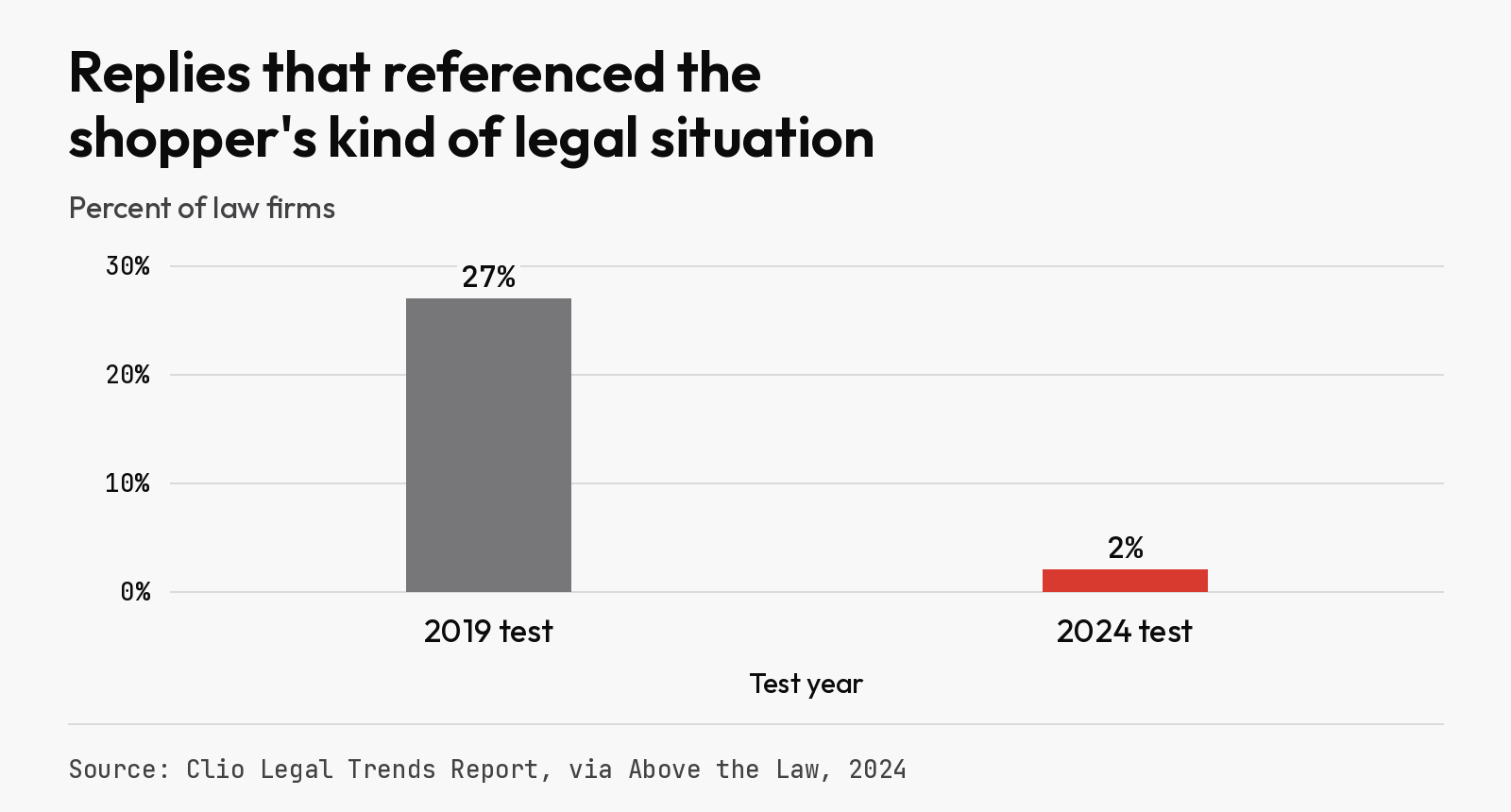
Firms that referenced the shopper's kind of legal situation, 2019 and 2024. Source: Clio Legal Trends Report, via Above the Law (Oct 8, 2024).
Score each reply on four questions:
- Did it answer the question the person asked?
- Did it say how to proceed, such as a booking link or a time to talk?
- Did it give a sense of cost, or say when cost will come up?
- Did it name who will follow up?
Those questions track what people told Clio in its 2019 consumer survey: 81% wanted a response to each question they asked, 80% wanted a clear sense of how to proceed, and 76% wanted to know what their legal issue could cost, the North Carolina Bar Association reported.
Fix the slowest channel first
Start with whichever channel scored worst. If email was slowest, give the inbox one owner and a set time to clear it each day. If after-hours calls went to voicemail, decide who returns them and by when. A person on the line counts for a lot here. Only 12% of Clio's 2024 shoppers said they were likely to recommend the firm they contacted, but shoppers who spoke with someone on the phone were more than three times as likely as average to recommend the firm, according to the Illinois commission's summary.
Then decide which replies a person sends and which an AI agent drafts for a person to approve. Firms have been slow to try this: in Clio's 2024 research, 7% of law firms used chatbots, and 7% of lawyers thought clients would prefer one. Yet 61% of clients said they would use a chatbot as a point of contact as long as they knew a human would eventually be available, Above the Law reported.
How we set up intake agents for law firms
When we set up an intake agent for a firm, every web form and missed call gets an immediate reply. The agent sums up the inquiry and sends it to the right person, with a booking link. Nothing that amounts to legal advice is automated, and we agree with the firm on what the agent may say on its own and what needs a person. Every form also carries one short line, in the firm's own words, saying that contacting the firm doesn't create an attorney-client relationship.
Before an agent goes live, we test it on sample data against a measure agreed up front. The secret shop above makes a good one: run it before launch and again after. Rules on communicating with prospective clients vary by state, so check yours before any reply goes out automatically.
Next step
Send your firm the test inquiry tonight and log the reply times. Fix the slowest channel first. Our AI agent teams page shows how an intake agent works alongside your staff, and our law firm websites page covers intake that works on a phone.
Frequently asked questions
How fast should a law firm respond to a new inquiry?
Within 24 hours at the latest. LawSites, citing Clio's research, reports that 79% of prospective clients expect a reply in that window. Set a shorter target for your own firm, measure it with a test inquiry like the one above, and decide who covers evenings and weekends so that inquiries sent at night don't wait until Monday.
What is a secret shopper test for a law firm?
It's a test where someone poses as a prospective client and contacts your firm the way a real one would, by web form, email and phone, then records how fast and how well the firm replies. Clio has run large versions for its Legal Trends Reports. A small firm can run its own with one made-up inquiry and a log of reply times.
Can an AI agent answer law firm inquiries?
It can send an immediate acknowledgment, collect contact and matter details, offer a booking link and pass the inquiry to a person. Nothing that amounts to legal advice should be automated, and your state's rules on communicating with prospective clients still apply. In Clio's 2024 research, 51% of prospective clients agreed that chatbots can be a helpful starting point for exploring legal options, according to the Illinois Supreme Court Commission on Professionalism.
What should a first reply to a prospective client include?
A useful first reply answers the question the person asked, says how to proceed, such as a booking link or a time to talk, and names who will follow up. If the firm can't discuss fees yet, the reply should say when it will. It should also carry the firm's own note that contacting the firm doesn't create an attorney-client relationship.