Nonprofit website trust signals belong on the donation page
In Independent Sector's 2026 survey, 74% said openness about how a nonprofit uses its funds would raise their trust. Put those facts on your donation page.
A nonprofit's donation page should say, in a sentence or two, what a gift pays for and where the organization's money comes from, with its latest Form 990 one click away. That's our view, and it starts from what people say builds their trust. In Independent Sector's Trust in Nonprofits and Philanthropy study, 74% of Americans said a nonprofit being open about how it uses its funds would raise their trust.
What people say would raise their trust
Independent Sector has run the study with Edelman Data & Intelligence for seven years. The 2026 edition surveyed 3,000 US adults online from April 3 to 20, 2026, with a margin of error of plus or minus two points. 56% reported high trust in nonprofits, stable from 2025 and higher than for any other major institution the study measured, including large corporations and government.
Besides the 74% for how funds are used, 73% said their trust would be positively affected by a nonprofit being open about where its funding comes from. 62% said the same of a governing board that includes people who have used the organization's services.
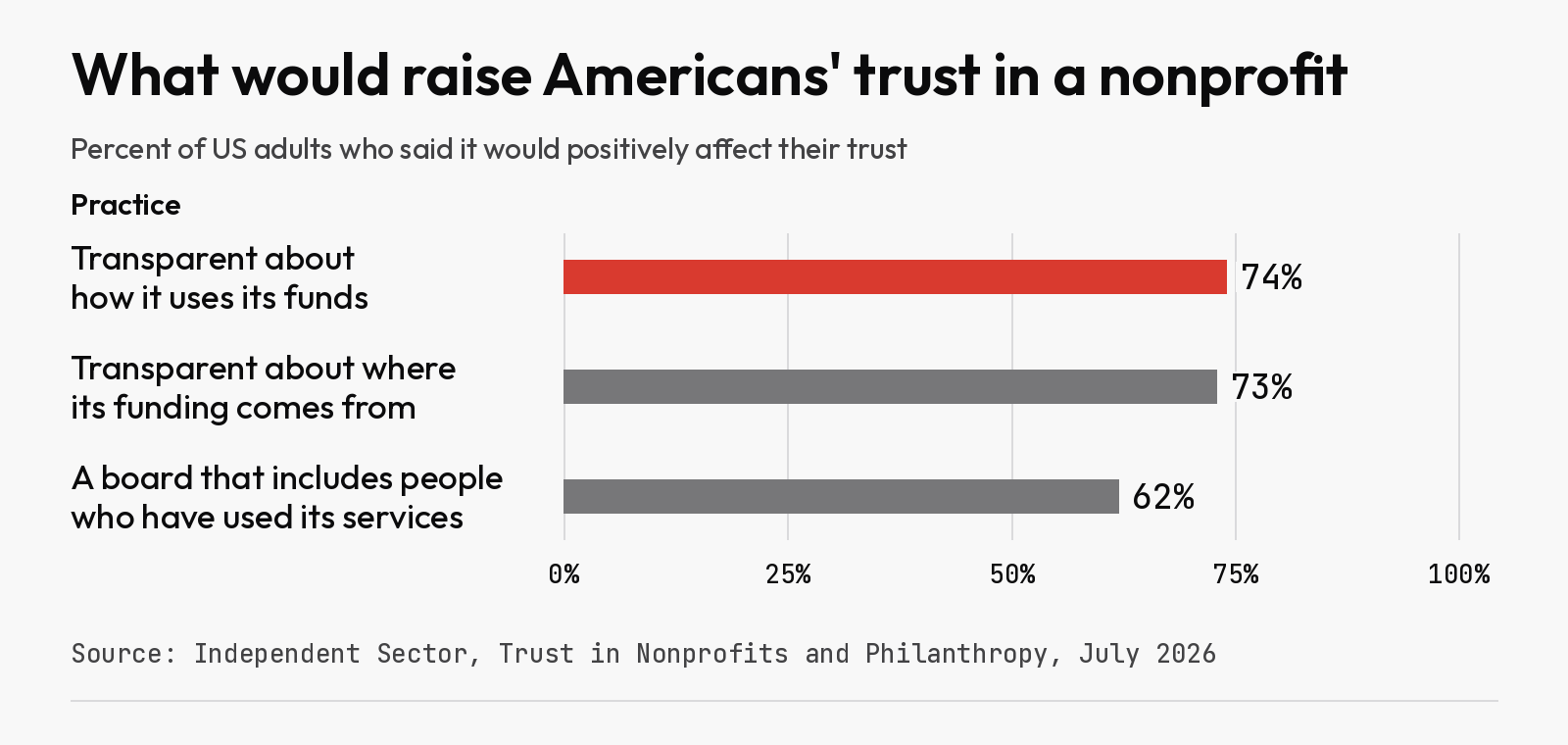
Share of US adults who said each would positively affect their trust in a nonprofit, April 2026. Source: Independent Sector, Trust in Nonprofits and Philanthropy (Jul 22, 2026).
The study also asked about specific responsibilities. In Independent Sector's July 2026 polling release, 47% said they trust nonprofits to use funds responsibly. That's well ahead of the 31% who said so of corporations, and still short of half.
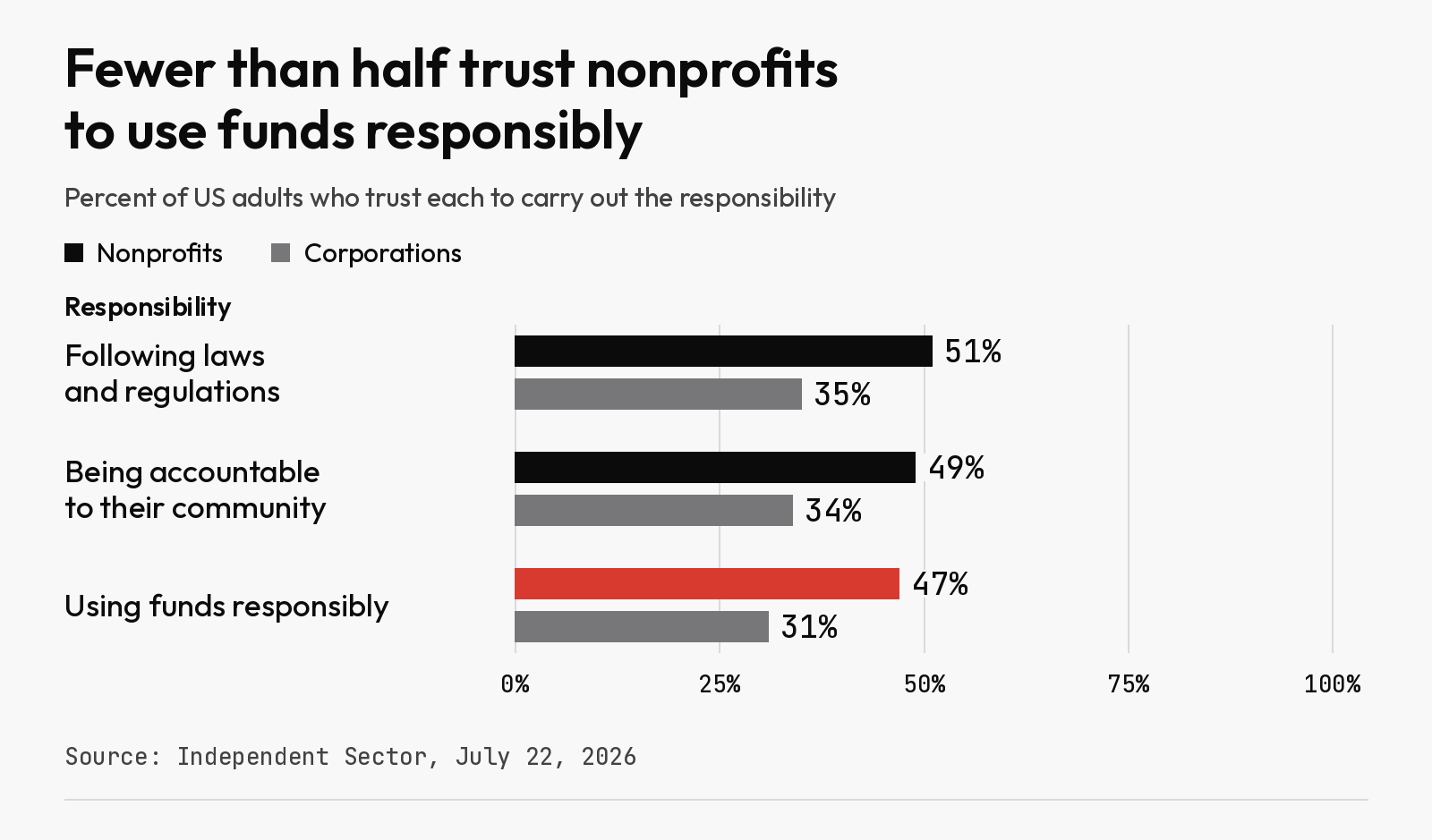
Share of US adults who trust nonprofits and corporations to carry out each responsibility, April 2026. Source: Independent Sector (Jul 22, 2026).
Nonprofit leaders say trust is harder to earn
Leaders see the same problem from the inside. Momentive Software, which sells software to nonprofits and other mission-driven groups, had Wakefield Research survey nonprofit leaders for its 2026 Nonprofit Trends Report. 89% said donor and stakeholder trust is harder to earn than it was three years ago, according to NonProfit PRO's report on the Momentive survey. 51% said they rely on impact reports and outcome data to build trust, and 45% said they proactively communicate how funds are used.
This is vendor research, and the write-up doesn't say how many leaders took part.
Our view: put the facts where donors decide
If your financial facts live in an annual report PDF or behind a link in the footer, a first-time donor on the donation page won't see them while deciding whether to give. We'd put a short answer on the donation page itself, with links to the details.
The BBB Wise Giving Alliance's Standards for Charity Accountability point the same way. Standard 17 asks any charity website that solicits contributions to carry the information the alliance recommends for an annual report. That covers the mission, the past year's program accomplishments, the board and officers, and three financial figures: total income, expenses split into program, fundraising and administrative costs, and ending net assets. It also asks for the charity's mailing address and electronic access to its most recent IRS Form 990. In the alliance's words, "Why should a donor need to go to a third-party source to get this popular government document that the charity files each year?"
What to put on the donation page
Keep the page short, and link to the long version:
- A sentence or two on what a gift pays for, tied to a named program. BBB's guidance says an appeal for donations should describe the specific program activities the money is for.
- Where your funding comes from, by type, such as individual donors, foundations and government grants. You don't have to name donors to do this. Under the IRS's rules on documents subject to public disclosure, a tax-exempt organization other than a private foundation isn't required to disclose the name and address of any contributor.
- A link to your latest Form 990, and your mailing address.
- Your board list, or a link to it.
- One program result with its date, in figures that match your financial statements. BBB's reviewers may ask a charity to show that the financial figures in its appeals match its financial statements.
Then pick a date to update these facts each year, such as when your Form 990 is filed. A page that still shows old numbers works against the trust it's meant to build.
How we build this into a nonprofit site
On the nonprofit sites we build, impact pages show what a gift does with figures the organization can stand behind. In the planning step we agree on the sitemap and the content plan with you, and in the build we set up giving along with the site's forms, analytics and redirects. Sites are built in WordPress and Elementor, so your staff can update the figures each year without a developer, and we train them before launch.
Next step
Open your donation page on a phone, as a first-time donor would, and look for what a gift pays for. If you have to leave the page to find out, start with the sentence about the gift and the link to your 990. Our nonprofit websites page shows how we plan and build these pages.
Frequently asked questions
What are trust signals on a nonprofit website?
They're the facts that let a visitor check an organization before giving, on the organization's own site. The useful ones are specific, such as a named program, a year's income and expenses, the board and a mailing address. Ratings and seals from outside groups can count too. Link to them from your page, so donors don't have to search for them.
Is a nonprofit's Form 990 public?
Yes. The IRS requires tax-exempt organizations to make their annual returns available to the public for three years, starting from the return's due date or the date it was filed, whichever is later. Churches and other houses of worship aren't required to file a Form 990, BBB notes. If you file one, a link on your site points donors to a document they could already ask you for.
How often should a nonprofit update the financial facts on its site?
Once a year at minimum, on a set date, such as when the Form 990 is filed or the annual audit is done. Put the year next to each figure so donors can see how current it is. BBB's reviewers may look at whether stories, photos or statistics older than three years are presented as current, which makes a useful outer limit.
Does showing where the money goes raise donations?
We can't promise it will. The surveys in this post measure trust, and none of them tracks gifts. They do show that people say these facts would raise their trust, and the donation page is where a donor decides whether to give.
Should a nonprofit say how it uses AI?
Yes, briefly. In Independent Sector's 2026 survey, 76% agreed that nonprofits should fully disclose when and how they use AI. 37% said a nonprofit's AI use would make them less likely to trust it, against 22% more likely. A sentence on what you use AI for, and what a person checks, can sit on your About page.