Website traffic down? Check these causes before blaming AI
Before you blame AI summaries for a traffic drop, check your tracking, Google's November 2026 core update and your crawler settings, in that order.
If your website traffic fell this fall, AI summaries in Google may be part of the reason. Before you blame them, check four other causes in order: a change to your tracking, a Google ranking update, search crawlers blocked from your site and a spam policy problem. All four can look like an AI-driven drop in a traffic report, and three of them are yours to fix.
Start with the date the drop began
Write down the day the drop started and put it at the top of the report. Every check below compares against that date.
Then put two numbers side by side for the same weeks: clicks from Google in Search Console's Performance report, and visits in your analytics. If Search Console clicks held steady while analytics visits fell, the people are probably still coming, and the problem is in how visits get counted.
Check whether your tracking changed
Look for anything that changed on the site around that date, starting with the cookie banner. Under Google's consent mode documentation, the basic setup blocks Google's tags until the visitor gives consent, so anyone who ignores the banner or declines isn't counted. The advanced setup loads tags with consent denied by default and adjusts what they collect. A new banner, or a switch from the advanced setup to the basic one, can cut reported visits while the same people keep coming.
Also check for a tag that went missing in a redesign, a new analytics property or a filter someone added. Then read Search Console's data anomalies page, where Google lists its own reporting problems. It shows two that may sit in this year's numbers: a logging error lowered impressions in the generative AI report for Nov 9 to 11, 2026, and FAQ rich results stopped appearing in Google on May 7, 2026, so reported FAQ impressions dropped from that day.
Line the date up with Google's updates
Google's Search Status Dashboard lists each confirmed ranking update with its start and end dates. In 2026 that includes core updates in March, May and November, and spam updates in March, June, August and September. The November 2026 core update ran from Nov 10 to Nov 24. On Nov 24, Google also pre-announced a December 2026 core update.
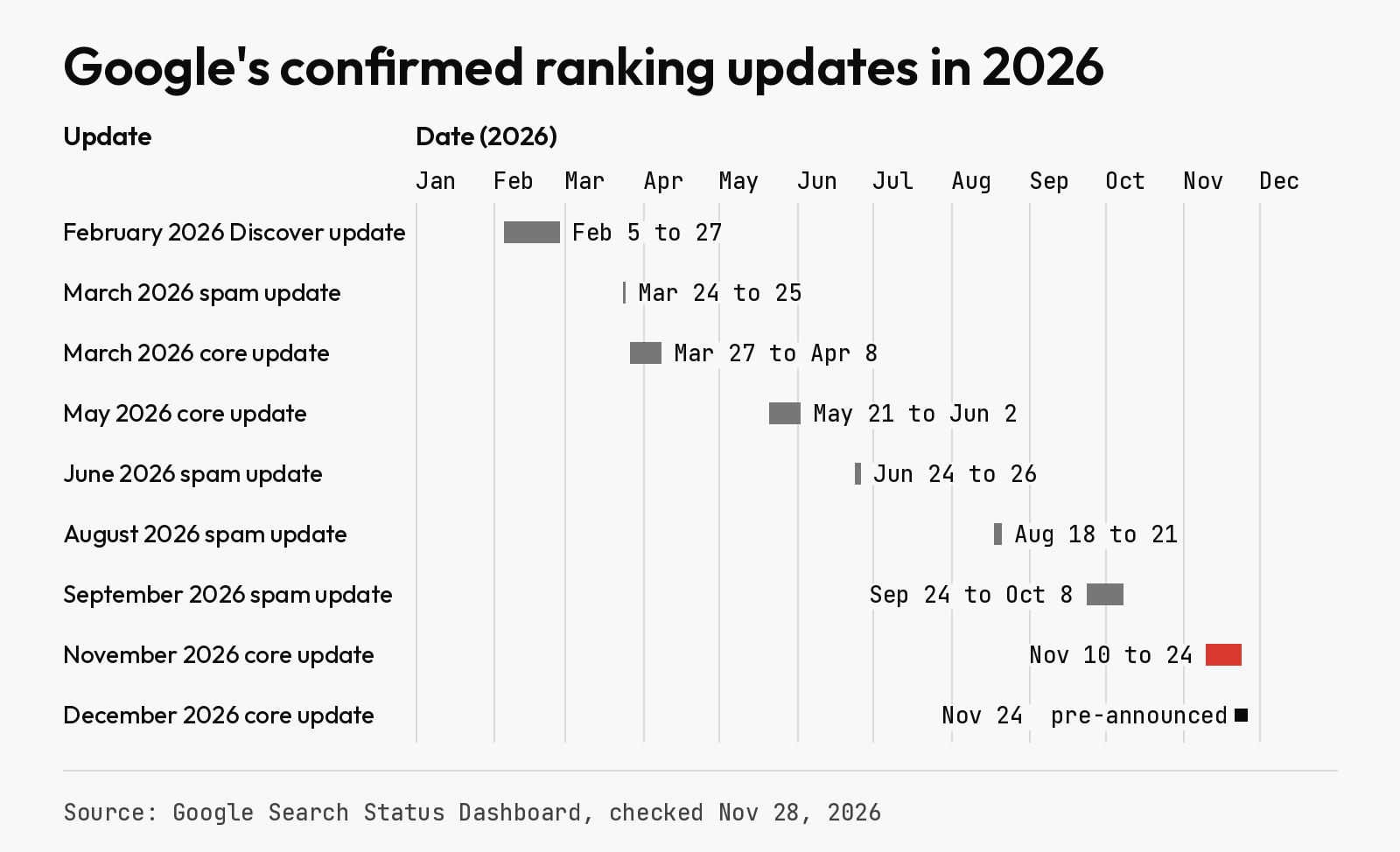
Google ranking updates in 2026, by start and end date. Source: Google Search Status Dashboard, checked Nov 28, 2026.
If your drop started between Nov 10 and Nov 24, the November core update is the first suspect. Google's guidance on core updates says to wait at least a full week after an update finishes, then compare that week with a week before it started. For the November update, that means comparing a week from Dec 1 onward with the week of Nov 3. Mark the December update's dates when it starts, too, or your January comparison will mix two updates.
The same guidance separates small drops from large ones. Slipping from position 2 to 4 needs no drastic action, and Google recommends leaving content that's already performing well alone. A fall from position 4 to 29 calls for a deeper look.
Make sure search crawlers can still reach your site
Since Sept 15, 2026, Cloudflare's Block and "Block on pages with ads" settings for AI training also apply to crawlers that serve search, including Googlebot, Bingbot and Applebot (Cloudflare's announcement). Picking Block to keep AI companies from training on your content now blocks those search crawlers too. Cloudflare added a Disallow AI Training setting for owners who want search without training, and moved existing training blocks to it. A hand-written firewall rule can still shut out search crawlers, so read your rules as well.
To confirm Google can reach a page, run it through the URL Inspection tool in Search Console and use the live test.
Rule out a spam policy problem
Back button hijacking is when a page stops visitors from going back to where they came from and sends them somewhere else. Google announced its back button hijacking policy on Apr 13, 2026, and has enforced it since June 15. Google warns that it can come from a library your site includes or from an advertising platform, so a site can break the rule without anyone on staff writing that code.
Open your main pages on a phone, tap back and check that you land where you started. Then look at the Manual actions report in Search Console.
Then measure what AI summaries are doing
Once those checks come back clean, look at AI. The research links AI summaries to fewer clicks. A Pew Research Center study tracked the browsing of 900 US adults in March 2025. Google users clicked a traditional result in 8% of visits when an AI summary appeared, against 15% when none did. They clicked a link inside the summary in 1% of visits, and they ended their browsing session 26% of the time, against 16% without a summary.
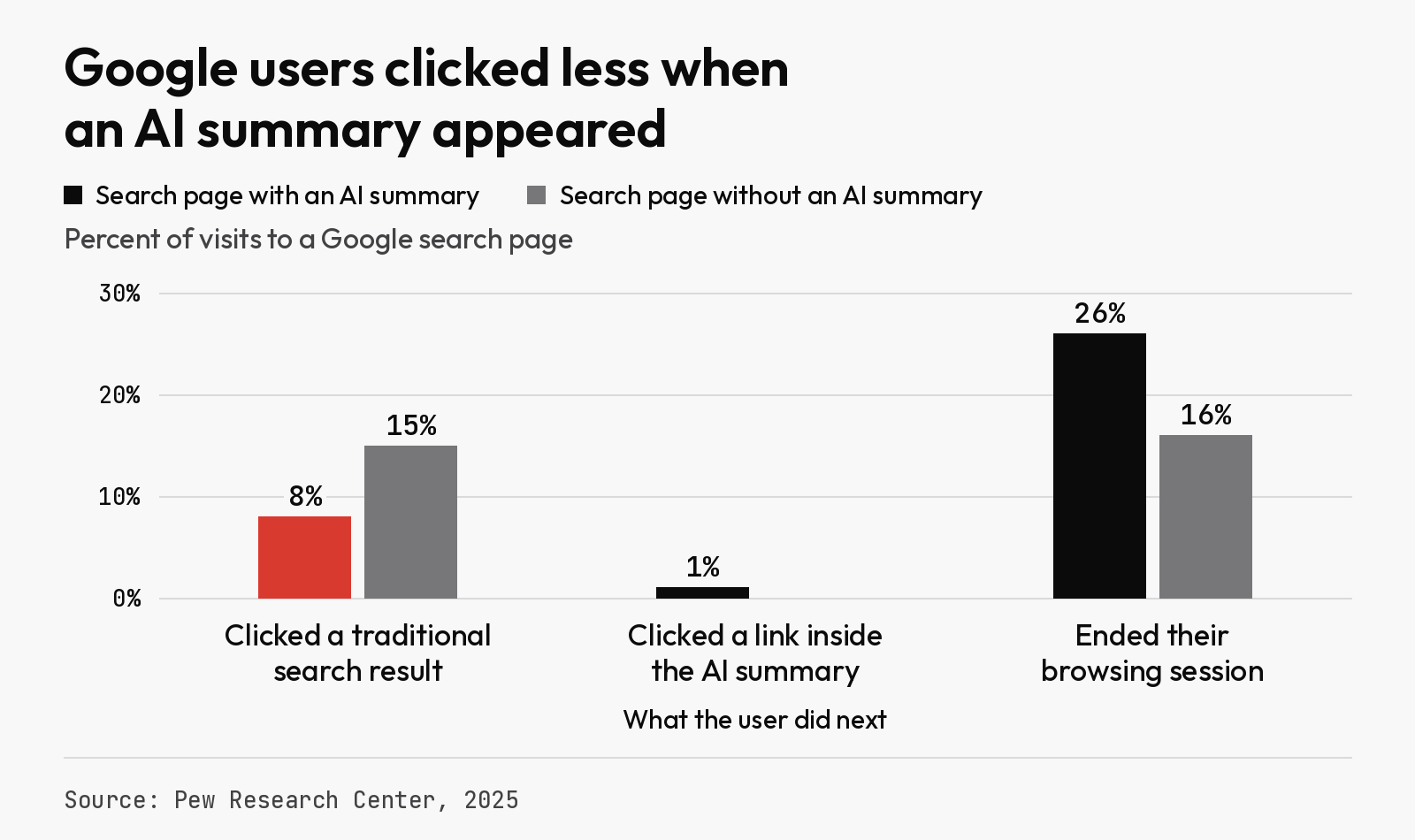
What Google users did after a search, with and without an AI summary, March 2025. Source: Pew Research Center (July 22, 2025).
In Pew's data, a summary cut clicks on regular results almost in half. Ahrefs' 2026 rerun of its AI Overviews click study found a 58% lower click rate for the top result on keywords that showed an AI Overview: 0.016 in December 2025, against 0.037 forecast without one. Both point to fewer clicks when a summary appears, and neither can tell you what happened on your site.
For that, use your own reports. Search Console's generative AI performance report shows how often your pages appear in AI Overviews and AI Mode, counted as impressions rather than clicks. Bing Webmaster Tools' AI Performance report counts how often Copilot and Bing's AI summaries cite your pages.
What we compare when traffic drops
In the monthly report we send our SEO and AI search clients, Search Console clicks sit next to Search Console's generative AI report, Bing's AI citations, visits from AI assistants in Google Analytics and searches for the client's name. Each month we also run a fixed set of buyer questions in the main AI assistants, and the forms ask how people heard about the client. When one number drops, we can see whether the others moved with it.
Next step
Put the date the drop began at the top of your year-end report and run these checks in order. Only after they come back clean is it worth changing pages. If you'd like a second pair of eyes, our SEO and AI search page explains how we review a site.
Frequently asked questions
Why did my website traffic drop suddenly?
A sudden drop usually comes from a change on your side or on Google's. On your side, look for a new cookie banner, a missing analytics tag, a firewall or Cloudflare setting that blocks search crawlers, or a script that breaks the back button. On Google's side, check the Search Status Dashboard for an update that started the same day, and the data anomalies page for a reporting error.
Do AI Overviews reduce website traffic?
Studies link them to fewer clicks, though the size of the effect varies by search. In Pew's March 2025 data, people clicked a regular result in 8% of visits with a summary and 15% without one. Pew also found that 88% of the summaries it saw cited three or more sources, so a summary usually points to several sites. Search Console's generative AI report shows whether yours is among them.
How do I know if a Google core update affected my site?
Compare the right weeks. Google suggests waiting at least a week after the update finishes, then comparing that week with the week before it began, using Search Console's Performance report. A drop that starts on the update's first days and spreads across many pages points to the update. A drop on a single page or a single day points elsewhere.
Can Cloudflare block Googlebot?
Yes. Since Sept 15, 2026, Cloudflare's Block and "Block on pages with ads" settings for AI training also stop Googlebot, Bingbot and Applebot, which takes your pages out of reach for search as well as training. To refuse training and stay in search, Cloudflare offers a Disallow AI Training setting. A hand-written firewall rule can also block search crawlers.